Del Shannon
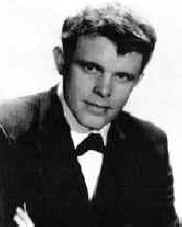
One of the best and most original rockers of the early '60s, Del
Shannon was also one of the least typical. Although classified at
times as a teen idol, he favored brooding themes of abandonment,
loss, and rejection. In some respects he looked forward to the
British Invasion with his frequent use of minor chords and his
ability to write most of his own material.
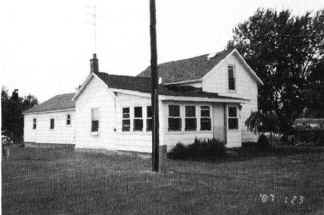
Boyhood Coopersville house
Charles Weedon Westover (nee Del Shannon)
was born in Grand Rapids, Michigan on December 30, 1934 to Bert
and Leone. Westover grew up in nearby Coopersville, a small
farming town where he married his childhood sweetheart when he
was seventeen. Shannon was fourteen when he learned to play
the guitar and began performing in local school shows. After
graduating from high school, he took his stage name from a friend
(Mark Shannon) and his boss's car (a Cadillac Coupe DeVille)
Shannon happened upon a gripping series of minor chords
while playing with his band in Battle Creek, MI. The chords would
form the basis for his 1961 debut single, "Runaway,"
one of the greatest hits of the early '60s.

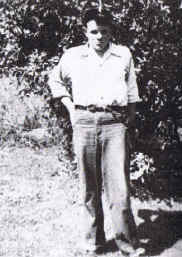
Shannon at eight years
|
|
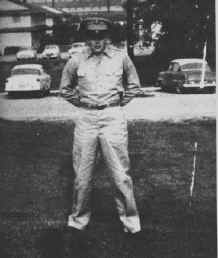
U.S. Army - Fort Knox, Kentucky
|

Cool Flames - Shannon far left
|

|
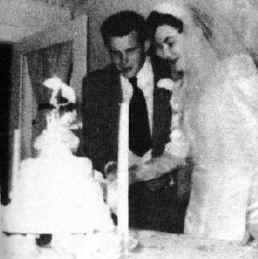
Wedding day with Shirley1954
|
Westover was drafted into the U.S. Army in 1954.
Stationed in Stuttgart, Germany, he polished his guitar playing
skills in the 7th Army's Get Up And Go program. While in
the army he played with a band called the Cool Flames. Discharged
in 1958, Westover returned to Michigan with wife Shirley where
they settled in Battle Creek, Michigan.

Hi- Lo Club in Battle Creek, Michigan
|

Moonlight Ramblers
Charlie Westover, Doug DuMont and Loren Dugger
|
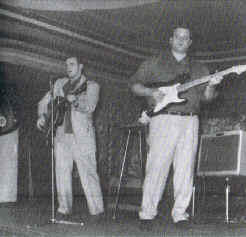
At the Hi-Lo Club
Del Shannon and Bob DuMont
|

Carpet Outlet where Shannon wrote the words to
"Runway"
|
After his discharge, he put together the Midnight
Ramblers and started playing clubs between Grand Rapids and
Detroit. He sold carpet and drove a truck during the day for a
furniture factory while in the evening he was a part-time rhythm
guitarist Doug DeMont's the Moonlight Ramblers The Ramblers
became the house band at the Hi-Lo Club. The act was a mixture of
influences that varied from rock and roll to Hank Williams to the
Ink Spots. Shannon made two important changes. He assumed the
stage name Del Shannon and added keyboard player Max Crook.

Ollie McLaughlin
|
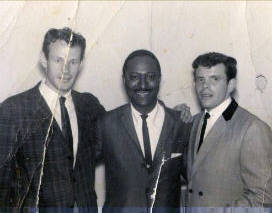
L-R: Max Crook, Ollie McLaughlin,
Del Shannon
|
It was Crook that introduced Shannon to Ollie
McLaughlin, a black deejay from Ann Arbor, who began to champion
the band. McLaughlin made a few demo tapes and brought them to
Irving Micahnik and Harry Balk of Embee Records. In October,1960
they signed them to Detroit's Big Top Records. He was then sent
to New York to Bell Recording Studio. The results were four
unsatisfactory songs. Shannon returned to Battle Creek and the
Hi-Lo with instructions from Balk to write better
songs..

|

Max Crook with Musitron and other
equipment
|
One night four months later, Crook was playing
the same two chords A-minor and C Major, A-minor and G-Major,
over and over. Shannon and the rest of the band joined in. For
fifteen minutes they played the hypnotic tune. Shannon began
adding lyrics "As I Walk Along, I Wonder What Went
Wrong..." The next day they completed the song, and Balk and
Micahnik accompanied Shannon to New York This trip Shannon
recorded "Runaway'"with its galloping beat, Max Crook's
proto- synthesizer Musitron solo, and Shannon's nearly hiccuping
falsetto. "Runaway" went all the way to number one in
1961. Shannon followed it up with the similar "Hats Off To
Larry" (#5), "So Long Baby" (#28), and "Hey!
Little Girl" (#38) in 1961 and "Little Town Flirt"
in 1962. Shannon's hit streak suffered somewhat in early '62 with
two big flops, "Ginny In The Mirror" and "Cry
Myself To Sleep," although the latter proved to be the chief
inspiration for Elton John's "Crocodile Rock." His
managers concerned, Shannon was flown to Nashville to develop a
new sound. Shannon was given Roger Miller's "The Swiss
Maid" to record.

Peter Asher, Del Shannon and Gordon Waller
These songs were even more successful in England,
where Shannon was huge. On one of his European tours in 1963, he
played some shows with the Beatles, who had just scored their
first big British hits. Shannon, impressed by what he heard,
would become the first American artist to cover a Beatles song
when he recorded "From Me to You" for a 1963 single
(although it would give him only a very small hit). Shannon's
melodic style had some similarities with the burgeoning pop/rock
wing of the British Invasion, and in 1965 Peter & Gordon
would cover a Shannon composition, "I Go to Pieces,"
for a Top Ten hit.

Bell Sound Studios (L to R) Harry
Balk, Del Shannon, Irv Micahnik
|

Bell Sound Studios
Producer Harry Balk, Arranger Bill Ramal, Del Shannon,
Max Crook, guitarist Al Casamenti
|

|

Signing with Liberty Records in 1966
|
In 1963 Shannon had legal problems with Balk and
Micahnik, which went on for the next ten years. Shannon then
formed Berlee Records, which was named after his parents and had
a minor hit with "Sue's Gotta Be Mine" in late
1963. Switching to Amy Records, Shannon had a Top 25
hit with "Handy Man" and got into the Top Ten with a
late-1964 single, "Keep Searchin'," that was one of his
best and hardest-rocking outings. But after the similar
"Stranger in Town" (#30, 1965), he wouldn't enter the
Top 40 again for nearly a couple of decades. By 1966 Shannon had
moved to Los Angeles and switched to a bigger label
(Liberty), where producer Snuff Garrett and arranger Leon Russell
attempted to mold him into a teen idol. It didn't bring the
expected commercial results, although he was continuing to
release quality singles. Part of the problem was that some of
these were a bit too eager to recycle some of his stock
minor-keyed riffs, as good as his prototype was. Shannon was
asked to record "Action" the theme for the television
show "Where the Action Is," which he turned down and
became a top twenty hit for Freddy Cannon.
A brief association with producer Andrew Loog
Oldham (also manager/producer of the Rolling Stones) found him
continuing to evolve, developing a more baroque, orchestrated
pop/rock sound, and employing British session musicians such as
Nicky Hopkins. Much to Shannon's frustration, Liberty decided not
to release the album that resulted from the collaboration (some
of the material appeared on singles, and much of the rest of the
sessions would eventually be issued for the collector market).
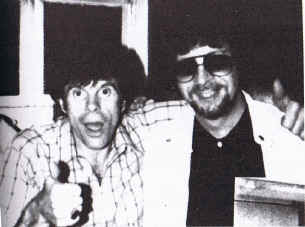
Shannon with Jeff Lynne
|
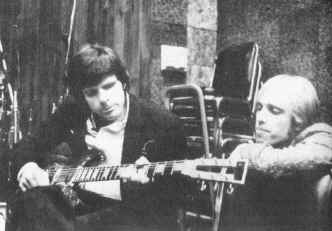
Shannon with Tom Petty
|
By the late '60s, Shannon was devoting much of
his energy to producing other artists, most notably Smith and
Brian Hyland ("Gypsy Woman"). Shannon was a perennially
popular artist on the oldies circuit (particularly in Europe,
where he had an especially devoted audience), and was always up
for a comeback attempt on record. Sessions with Jeff Lynne and
Dave Edmunds in the '70s didn't amount to much, but an early '80s
album produced by Tom Petty (and featuring members of the
Heartbreakers as backing musicians) got him into the Top 40 again
with a cover of "Sea of Love." However, Shannon was
unable to sustain a career outside the oldies revival circuit.
Through the remainder of the decade Shannon
continued to perform, although he was financially secure. He was
working on another comeback album (later released after his death
as Rock On) with Jeff Lynne, and sometimes rumored as a
replacement for Roy Orbison in the Traveling Wilburys.

Photo from Shannon's final performance
|

Death Certificate
|

Shannon family
Top - Del Shannon and Shirley Shannon
Bottom from left - Jody, Craig and Kym
|
On February 3, 1990, Shannon performed at the
annual Buddy Holly concert in Clear Lake, Iowa. Five days later,
back home in Santa Clarita Valley, California. Shannon
unexpectedly killed himself while on Prozac, an anti-depressant
drug. He had taken a .22 caliber rifle and shot himself at his
home. At that time he was married to his second wife, Beverly
LeAnne Gutierrz and had three grown children from his first
marriage to Shirley.
Shannon's wife filed suit a year late against the
makers of the drug Prozac claiming that its use contributed to
Shannon's death.

Del Shannon's Runaway "Historic Site"
Marker, dedicated September 29, 1990 in Battle Creek,
Michigan
|

Del Shannon's Sea of Love "Historic
Site" Marker, dedicated September 29, 1990 in Battle
Creek, Michigan
|

Memorial in Shannon's hometown Cooperville, MI
|

Del's daughters Kym and Jody with his manager Dan
Bourgoise at the Rock and Roll Hall of Fame Ceremonies
|
Del Shannon died February 8, 1990, he was 55. he
died by suicide, shooting himself with a .22 caliber
rifle at his home in Santa Clarita, California.
Max Crook died July 1, 2020.
Del Shannon was inducted into was inducted into
the Rock
and Roll Hall of Fame in 1999
Del Shannon
The Young
Sisters