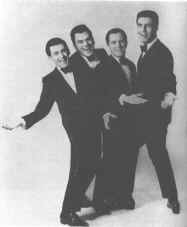
The Four Seasons
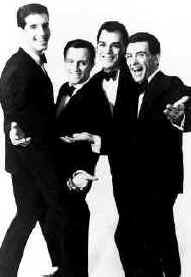
(l to r) Tommy Devito, Frankie Valli, Nick
Marsi, Bob Gaudio
One of the most long-lived and successful white vocal groups of
the '60s, The Four Seasons scored a series of smash
hit singles between 1962 and 1967 featuring the shrill
piercing falsetto (three octave) voice of Frankie Valli. During
their nearly 40 year career Frankie Valli and the Four
Seasons sold over a 100 million records making them the most long
lived and successful white doo wop group.
Members:
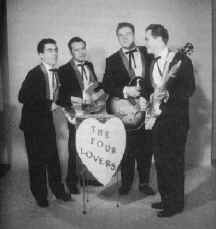
Four Lovers
Frankie Valli real name Francesco Castelluccio - drums
Tommy DeVito - lead guitar
Nick DeVito - guitar
Frank Majewski - bass guitar |
Four Seasons
Fankie Valli
Nick Massi
Tommy DeVito
Bob Gaudio |
|
|
Born Francis Castelluccio in 1937, Fankie Valli
was one of three brothers who grew up in a tough, working-class
neighborhood in Newark, New Jersey. His father worked as a barber
and later for the Lionel train company. His Italian-born mother
encouraged Valli's early interest in music. The two would make
weekly treks to hear major big bands of the era perform at the
Adams Theater, in Newark, or the Paramount Theater, in New York
City. Valli was more influenced by jazz, however, and
particularly enjoyed listening to the Four Freshmen, the Hi-Los,
and the Modernaires. He also admired classic R&B bands
including the Clovers and the Drifters. As a child, Valli had no
formal vocal training but instead taught himself to sing by doing
impressions of other artists. Since he had a naturally high
voice, he focused on singers Rose Murphy and Dinah Washington.
At the age of seven, Valli's future course was
set when he saw a young Frank Sinatra perform at the Paramount.
As a teenager in the 1950s, Valli sang with several Jersey groups
at school events and in local clubs. Valli started out solo with
his first solo recording, in 1953, was "My Mother's
Eyes". He formed The Varietones with guitarist brothers Nick
and Tommy DeVito and bassist Hank Majewski around 1954.
Changing their name to The Four Lovers in 1956.they signed with
RCA Victor Records that same year and had a minor hit with
"You Are the Apple of My Eye. After that the group played in
lounges for several years.
Valli's parents supported his interest in music,
though at times they were concerned about his slowly blooming
career.
What made Valli uncommon as a singer, especially while trying to
carve a niche in those early days, was his stratospheric
falsetto. Critics called Valli's vocals everything from shrill to
shrieking, but the falsetto remained his signature sound. His
remarkable range allowed him to create expert harmonies, and the
singer was amply able to hit high notes without his voice
breaking.
Following the group's initial wave of success in 1956, the
quartet performed three times on the Ed Sullivan Show and found
themselves rubbing elbows with another rising star, Elvis
Presley.
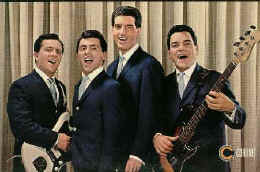
By 1960, Bob Guadio and Nick Massi had replaced
Nick DeVito and Hank Majewski. In 1961 the group changed their
named to The Four Seasons after a bowling alley in Union, New
Jersey where they were turned down for a cocktail-lounge job. The
group recorded the unsuccessful "Bermuda" for Gone
Records. before signing with Vee-Jee Records, help of
writer-producer Bob Crewe. With Guadio and Crewe acting as
principal songwriters, the group a #1 hit with Gaudio's
"Sherry" in the late summer of 1962.Crewe/Guadio's
"Big Girls Don't Cry," and "Walk Like a Man"
became top pop and R&B hits followed by pop hits "Candy
Girl," "Stay," and "Alone."
At the beginning of their career, the Four
Seasons viewed the Beach Boys as their only American rivals. In
1962, with the help of writer-producer Bob Crewe, the group
signed a recording contract with Vee Jay Records--becoming
the label's first white act--their star rose so high that they
became virtually untouchable by the competition. A year later,
the Beatles were signed to the same label, but the Four Seasons
would manage to survive the British Invasion
In 1962, the group recorded its first megahit,
"Sherry," written by Four Season keyboardist and tenor
Bob Gaudio. The song was reportedly a peace offering from
producer Bob Crew, who had infuriated Valli by allowing Elvis
Presley to record what would become the smash single "Don't
Be Cruel." "Sherry" received limited airplay until
an appearance on Dick Clark's television show American Bandstand
catapulted the song to the top of the pop charts, earning the
group its first gold record. Indeed, "Sherry" was one
of the fastest-rising songs ever released.
The song was quickly followed by a second hit, "Big Girls
Don't Cry," also written by Gaudio. Both tunes were
certified platinum after remaining Number One hits for five weeks
each. The Four Seasons had found their sound and continued to
score in 1963 with "Walk Like a Man," "Ain't That
a Shame," "Candy Girl," and "Marlena."
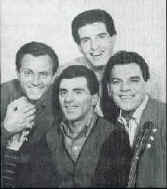
In 1964, following contractual disputes with Vee
Jay, the Four Seasons signed with Philips Records and enjoyed a
golden year, placing six songs in the Top Twenty:
"Stay," "Dawn (Go Away)," "Ronnie,"
"Rag Doll"--a Number One hit--"Save It for
Me," and "Big Man in Town."
In 1965 Massi left, but Valli and the Four
Seasons continued on a roll, releasing numerous songs each year
through 1968. Their 1966 arrangement of Cole Porter's "I've
Got You Under My Skin" was also an early hit for Frank
Sinatra, who became a friend of Valli's. In fact, the Four
Seasons performed at the Paramount Theater for a crowd of
screaming female fans 20 years after Valli had so admired
Sinatra's performance there. One memorable Four Seasons tune,
"Can't Take My Eyes Off of You," made it to the Number
Two slot in 1967. And though the Four Seasons sold nearly 80
million records during their peak years, Valli continued to drive
an old car and live in a housing project until the mid-1960s,
when success finally seemed real.
Life in the fast lane came to an abrupt halt for
the Four Seasons in 1968 with the release of Genuine
Imitation Life Gazette. Having strayed from their heretofore
surefire formula to produce what has been called the group's
attempt at a "relevant" or progressive album, the Four
Seasons were faced with their first monumental failure. It was
around this time that Bob Crew ended his association with Valli
and company, Gaudio assuming the role of producer. Further
difficulties loomed when the strain of constant touring,
compounded by litigation with Philips Records, pitted the Seasons
against one another. In 1970, Philips released Half and Half,
featuring the single "Patch of Blue," which rose only
as high as Number 94.
For several years the group languished without a label, until
they joined Mo-West, Motown's subsidiary on the West Coast. And
with the exception of the 1972 Mo-West album Chameleon, the Four
Seasons did not record together again until 1975. Valli, however,
made a solo comeback in 1974 with the mellow number "My Eyes
Adored You," a Number One hit that was eventually certified
double platinum. Two more singles, 1975's "Swearin' to
God" and "Our Day Will Come," solidified his
return to the limelight.
In 1975 the Four Seasons united to record the Warner Bros.
release "Who Loves You," co-written by Gaudio, which
pushed them back into the Top Ten. The following year, they went
all the way to Number One--for the first time in over a
decade--with the infectious coming-of-age ditty "December
1963 (Oh What a Night)," also co-penned by Gaudio.
Valli continued to record with the Four Seasons
until their breakup in 1977. He also concentrated on his solo act
but did not score another significant success until 1978. With
the release of Grease, the soundtrack of the
phenomenally popular movie for which Valli sang the title track,
some of his lost audience was reclaimed and a whole new crowd of
swooning teenagers won over. The film, which was set in the 1950s
and starred Olivia Newton-John and John Travolta, also provided
Valli with a bit of acting experience--in a cameo role playing
himself. Many of the album's songs were written by Bee Gee Barry
Gibb, which undoubtedly helped the disc soar to its Number One
position during the height of the disco era, created in part by
the Bee Gee's record-selling soundtrack to Saturday Night Fever.
Valli was at the zenith of his career with a triple-platinum hit.
The following decade saw Valli and Guadio re-formed The Four
Seasons in 1980 and formed FBI Records in 1984. They also
recorded and occasionally toured with a new Four Seasons, by this
time comprised of six members.
Many of the original group's best-known songs
became standard fare for club and concert performances.
1992 found Valli working on a new solo album as
well as promoting the Four Seasons disc Hope and Glory.
Frankie Valli and the Four Seasons were recognized in 1990 for
their impact on popular music with induction into the Rock and
Roll Hall of Fame alongside other classic acts such as The Who
and the Four Tops. Considering his still-driving energy, it
seemed likely that Valli's famous falsetto would delight
listeners for another 30 years.
The Four Seasons were inducted into the Rock and
Roll Hall of Fame in 1990.
The Four Seasons were inducted into the Vocal
Group Hall of Fame in 1999.
Tommy DeVito passed away in Nevada September 21,
2020 at the age of 92. He had recently been hospitalised after
contacting COVID-19.
Nick Massi passed away from cancer December 24, 2000, at his home
in West Orange, New Jersey.