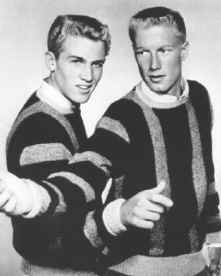
Early '60s purveyors of innocuous fun songs concerning surfing, cars, girls, and high school, Jan and Dean were second only to The Beach Boys in the promotion of these Southern California themes. Between their 1958 debut single, "Jennie Lee," and Jan Berry's near fatal car crash in April, 1966, Jan and Dean charted thirteen Top Thirty singles and selling over ten million records worldwide.
|
|
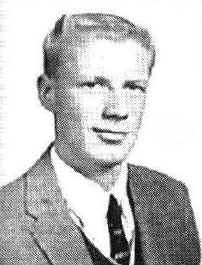
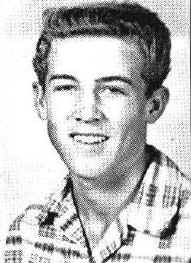
Jan Berry 9 (born April 3,1941) and Dean Torrence (born March 10, 1941) attended Jefferson Junior High School and University High School in West Los Angeles. They became friends while playing football (Jan -Tight End and Dean -Wide Receiver) during their senior year when their football lockers were next to each other. They first began singing together, along with some of their teammates, in the shower after practice. After football season, they moved to Jan's home in Bel Air where the family had a music room with piano and two Ampex reel to reel tape recorders. They were also members of the Barons, an informal all male club at University High. The Barons consisted of Chuck Steele (lead singer), Arnie Ginsberg (first tenor), Wally Agi (second tenor), John Saliman (second tenor), Jan (bass), and Dean (falsetto). Added to the group were Jan's neighbor Bruce Johnston because he could play the piano and Dean's neighbor Sandy Nelson on the drums. The Baron's first and only appearance was at their high school's talent show. After that all the members went to other interests leaving just Jan, Dean and .
The Barons
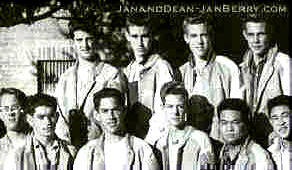
Back Row Third from left Jan Berry. Fourth
from left: James Bruderlin (Actor James Brolin).
Front Row: Second from left: Arnie Ginsburg. Third from left:
James Seligman
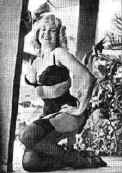
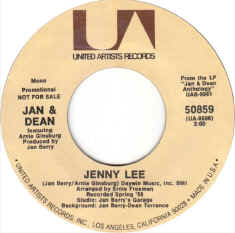
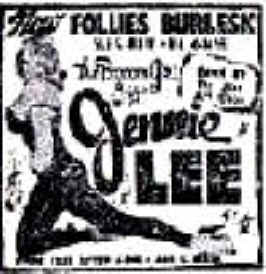
One night Berry, Torrence, and fellow Baron Arnie Ginsberg drove to downtown Los Angeles to the New Follies Burlesque. The star of the show that night was a well endowed stripper Jennie "The Bazoom Girl" Lee. As Jennie Lee went through her act the men in the audience were chanting bomp, bomp, bomp. While driving home after the show the boys began the bomp bomp chant, then added some lyrics and the result would later become a song called "Jennie Lee".
|
|
|
After working on "Jenny Lee" for a few
weeks, with Ginsberg writing the melody and two-thirds of the
words, Berry decided he'd like to record it for a Baron's party
at his house. With Torrence in the Army Reserve, Berry and
Ginsberg took the finished tape to a recording studio in
Hollywood.
While at the studio Joe Lubin, a producer for Arwin Records,
heard Berry and Ginsberg recording. Lubin offered to take the the
tape, add instrumentation, and put it out on the Arwin label. Two
months later "Jenny Lee" was a number one record.
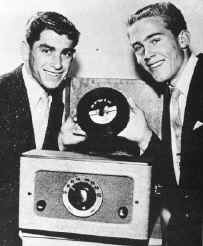
Upon completing active duty Torrence returned home. In the late fall 1958 he was invited to play football and it is there that he ran into Berry. After the game Berry invited him to his house to work on some music.
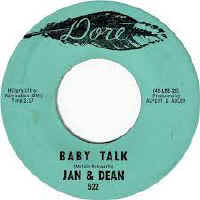
Unable to find or write anything, Berry decided to call friends Herb Alpert and Lou Adler. One of the songs they suggested was "Baby Talk." The four of them worked on " Baby Talk " for about a month. With both singing into a microphone and Berry playing the piano they would record several more versions with Berry picking out the parts he liked and then splicing them together until he had a master version. Alpert would write the arrangement for the rest of the instruments and then pick the session musicians to play the instrumental tracks. In recording studio, the studio musicians would put on earphones and the studio engineer would play the vocal track to them and the session men would play along. The original vocal track and the new instrumental track were then combined on to a new tape. This procedure was totally opposite of the way rock and roll records had been made.
October, 1959 they reached the Top Ten with "Baby Talk" and appeared on American Bandstand. They followed with "Heart and Soul," "A Sunday Kind of Love," "There's a Girl," "We Go Together," and a album Jan and Dean on Dore Records over the next three years
They then left Dore Records and signed a two
record deal with Gene Autry's Challenge Records. Jan
& Dean's first record on Challenge label was the old standard Heart and Soul
which hit number one on KFWB in L.A. On July 8, 1961 and
peaked at number 25 on the Billboard charts later that
summer. One more record was cut to fulfill their contract.
Heart and Soul
which hit number one on KFWB in L.A. On July 8, 1961 and
peaked at number 25 on the Billboard charts later that
summer. One more record was cut to fulfill their contract.
Jan and Dean now signed with Liberty Records. It took five records before they had a hit with " Linda." This song had been popular in the fifties and contrary to the rumor it was not written about Linda McCartney although there was a connection. The Linda that the song was written about had no interest in posing for a picture to be used for the cover of the sheet music, so a lawyer that was involved with the song suggested that his young daughters name was Linda, Linda Eastman and he thought it would be neat to have her picture on the sheet music, so her photo was featured on the final product. Linda Eastman went on to become Linda McCartney, Paul's wife.
In late 1962, Jan and Dean became surf music converts after performing at Hermosa Beach High School not far from the City of Hawthorne. Since they didn't have their own band the promoter hired a local group who just had their own hit record "Surfin' Safari" the Beach Boys. At one show the Beach Boys played a few songs and Jan and Dean followed with three or four. Seeing the enthusiastic crowd reaction they asked the Beach Boys if they'd like to do their set again and have them sing with them. They backed the Beach Boys on two songs and the crowd went wild and a life long friendship was started on that stage on a warm California spring evening in 1963.
The collaboration convinced Jan and Dean to include a surf song in their upcoming album, featured the song "Linda." Lou Adler, their record producer and manager suggested that the album be called Jan and Dean Take Linda Surfing. Not knowing any surfing songs, except the two the Beach Boys had done, Dean called Brian Wilson of the Beach Boys, and asked if the group would play the instrumental parts to "Surfin'" and "Surfin' Surfari" on the album. At the session, Wilson sang the opening line of a new song, which he offer to Jan and Dean. The duo added lyrics and recorded it as "Surf City," a song that in 1963 went to the top of the charts. The next year, they followed with "Ride the Wild Surf" and "Sidewalk Surfin'.
|
|
|
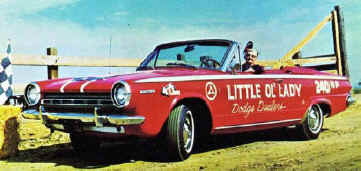
It's the Little Old Lady from Pasadena!
The Little Old Lady From Pasadena
(Go granny, go granny, go granny go)
Has a pretty little flower bed of white gardenias
(Go granny, go granny, go granny go)
But parked in her rickety garage
There's a brand new shiny red Superstock Dodge
(Chorus) And everyone's say that's there's
nobody meaner
Than the Little Old Lady from Pasadena
(She drives real fast and and she drives real hard)
She's the terror of Colorado Boulevard!
It's the Little Old Lady of Pasadena!
If you see her on the street don't try to
chose her
(Go granny, go granny, go granny go)
You might drive a goer but you'll never lose her
(Go granny, go granny, Go granny go)
Well, she's gonna get a ticket sooner or later
'cause she can'y keep her foot of the accelerator (Chorus)
The Guys come to race her from miles around
But she'll give them a length and shut them down
(Chorus)
While they lacked the Beach Boys' depth and capacity for artistic growth, Jan and Dean's hits from 1963 and 1964 -- which also included "The Little Old Lady (From Pasadena)," "Drag City," "Honolulu Lulu," and the mini-soap opera "Dead Man's Curve" -- are in the same class as the Beach Boys' early work in their infectious, energetic invocation of good times and California sunshine. They added an irresistibly reckless humor to the genre, and were well cast as the fun-loving hosts of the classic 1964 rock and roll hootenanny film The T.A.M.I. Show (for which they performed the rip-roaring theme, "(Here They Come) From All over the World".
All the while that Jan and Dean were recording stars and were flying around the country playing concerts on the weekends, they were both full-time college students, Dean in the school of architecture at the University of Southern California where he earned a bachelor degree in fine arts, and Jan at U.C.L.A. where he was pre-med and upon graduation he was accepted in medical school.
In 1964 Jan and Dean started Majic Lamp Records. Over two years they released fourteen singles, with some of them being by Johnny Burnette, Karen Carpenter and Davy Jones of the Monkees. Dean also founded J&D Records in 1966, but it folded after two releases
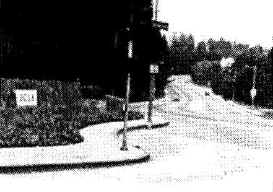
Deadman's Curve as it looked in thw 60s
The duo's success, already on the wane a bit, was tragically
cut short by Jan 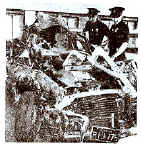 Berry's near-fatal auto accident in
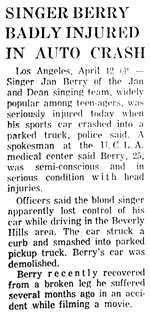 April1966, which had been eerily foreshadowed by the lyrics of
"Dead Man's Curve." April 12, 1966 on Whittier Drive in
Beverly Hills, Berry pulled out to pass a slow-moving vehicle and
slammed full-speed into a truck that was unexpectedly parked at
the curb. The Paramedics that arrived on the scene thought
Berry was dead. Checking his vital signs, they found he was
alive, and rushed him to the UCLA Hospital. There they found
Jan's brain had been severely damaged and even numerous major
brain surgeries could not completely repair the damage.. Not
expected to live, Berry was in a coma for months and awoke unable
walk, speak and was paralyzed on the right side. The name Jan
& Dean remained only in the memories and record collections
of their many fans for 10 years.
April1966, which had been eerily foreshadowed by the lyrics of
"Dead Man's Curve." April 12, 1966 on Whittier Drive in
Beverly Hills, Berry pulled out to pass a slow-moving vehicle and
slammed full-speed into a truck that was unexpectedly parked at
the curb. The Paramedics that arrived on the scene thought
Berry was dead. Checking his vital signs, they found he was
alive, and rushed him to the UCLA Hospital. There they found
Jan's brain had been severely damaged and even numerous major
brain surgeries could not completely repair the damage.. Not
expected to live, Berry was in a coma for months and awoke unable
walk, speak and was paralyzed on the right side. The name Jan
& Dean remained only in the memories and record collections
of their many fans for 10 years.
With Jan and Dean's career over as a result of Jan's accident,
Torrence turned his attention to design, which he'd been studying
at U.S.C. during Jan and Dean's recording career.

Sticking to the business he knew best, Torrence
opened Kittyhawk Graphics, a graphics design firm specializing in
music industry design and packaging.
In 1967, less than one year after Berry's accident, Kittyhawk was
sharing office space with an enterprising young producer named
James William Guercio, who came to Torrence with a design
project. Guercio wanted Torrence to help design a logo for a new
group Guercio was producing, called "Chicago Transit
Authority." Using elements of the Coca-Cola logo design,
Guercio and Torrence came up with a basic concept which was then
given to a lettering expert to refine and complete. That logo,
later shortened along with the group's name to
"Chicago" was Kittyhawk's first major project.
In early 1968 Dean designed the first of over two hundred album
packages to follow, "The Turtles Golden Hits."
In 1969 Dean designed the first of nine covers for The Nitty
Gritty Dirt Band, a relationship that continues to this day and
has resulted in three Grammy Award nominations for "Best
Album Cover of the Year"
In addition to those nominations, Torrence won a Grammy in 1972
for "Best Album Cover of the Year" for the album Pollution
by the group of the same name.
In 1969 Paul Morantz, a young law student at the
University of Southern California, met Jan Berry at a resort
motel in Palm Springs, California. Morantz and Berry became
instant friends. After listening to some of Berry's stories,
Morantz who dabbled in freelance writing, decided to write a
feature story about Berry and his struggle against all odds.
The story first appeared in the University of Southern California
Daily Trojan in a short-edited form. Later Morantz spent many
months re-writing the article for a California magazine called West.
Just about the time he was putting the finishing touches on the
story West stopped publishing.
By this time Morantz had graduated from law school, was busy
practicing law, and the story was shelved.
A couple of years later, Morantz dug out Berry's story.
Re-reading it Morantz realized that the story could easily be
expanded to include the whole Jan & Dean story. At this
point, Morantz called Torrence and they got together to discuss
what had begun to take on the proportions of a larger project.
After many regular meetings and major rewriting Morantz and
Torrence submitted the re-written story to Rolling Stone
magazine, after it had first been turned down by all of the major
general interest magazines on the ground that not enough people
would remember Jan & Dean to justify its publication.
Rolling Stone accepted the story with tremendous enthusiasm,
scheduling Jan & Dean to appear on their cover with the
article given a major spread within. The publication date was
September 12, 1974. But a funny thing happened on the way to the
press, Nixon resigned and Nixon's picture pushed Jan & Dean's
off the cover. But the story ran and was very well received.
There seemed to be a renewed interest in Jan & Dean. Torrence
and Morantz now decided that the story had all the elements of a
feature film, so they started writing a screen play and started
shopping the property all over town.
|
|
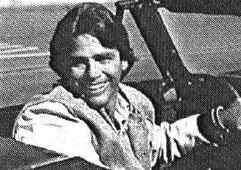
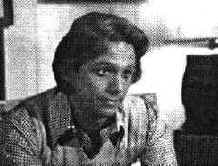
After two years of rejections a deal was finally made with CBS to make the movie for television. Dick Clark Productions filmed "Deadman's Curve" starring Richard Hatch ("Streets of San Francisco", "Battlestar Galactica"), Bruce Davison and guest-starring Dick Clark, Wolfman Jack, Mike Love, and Bruce Johnston of the Beach Boys was started in late 1977.
The very successful CBS-TV Movie "Deadman's Curve" airing in prime time nationwide in both 1978 and 1979, chronicled Berry's valiant fight to regain his ability to function normally.
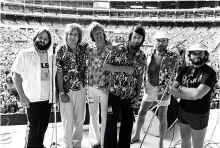
With a strong will, therapy, and the support of his partner, Dean Torrence, Jan & Dean toured with the Beach Boys in 1978 and 1979.
In 1986, on a friendship tour of the People's
Republic of China, they were the first to be allowed to
skateboard on China's Great Wall.
Now celebrating more than a decade of success together with their
reunion and are also celebrating over 30 years of sunshine music.
Jan & Dean made a surprise guest appearance on the Vicki
Lawrence Show, along with John Davidson and James Darren as
Vicki's teenage heart-throbs.
"The Courage of Jan Berry" aired as a feature segment
on Entertainment Tonight confirming a continuous and
growing career as a national concert attraction.
In 1994 Jan & Dean played Three Rivers Stadium with James Brown to 45,000 fans and after 15 years, reunited with the Beach Boys at Mile High Stadium rocking 55,000 fans.
Over the years, Jan and Dean have appeared at the largest stadiums as well as small county fairs. They've headlined Casinos from Las Vegas to Biloxi. They have performed at corporate parties and fraternity keggers. They have even done a few weddings and birthday parties.
Jan and Dean's career ended wth Jan Berry's death March 26, 2004, after he suffered a seizure, he was 62.