78s: (c. 1900 - 1960)
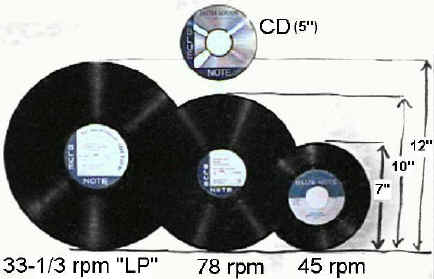
The first disc format was the 10-inch 78 rpm record, pictured
above in the center, invented around 1900. The first record
player was invented around 1870 by Thomas Edison, but this used
cylindrical records about the size of an empty toilet paper tube.
The flat 78s were much easier to store. The grooves on these
records were much larger than later LPs and 45s (about 4 times as
big) and the needles were larger too. 78s were recorded and
played back "acoustically", without any electric
amplifiers or microphones, until about 1925. 78s were obsolete by
about 1960. Since the grooves are so spaced out and the records
spin so fast, a standard 10-inch 78 can't hold more than about 3
minutes of music per side. They are typically made of a shellac
compound (as in furniture finish!), and have the consistency of a
china plate, so they are very thick and heavy and break easily.
33s / "LPs": (c. 1948 - 1990)
The 33, a.k.a. the "LP" (Long Playing record) or
"album", pictured above at left, was invented in 1948.
These LPs were popular until around 1990 when CDs were popular
enough to take over. An LP could hold up to a total of 60 minutes
of music, but most didn't have more than 40 minutes. They are
made of vinyl plastic rather than shellac, so they are more
flexible and don't tend to break like 78s. The grooves are 4
times smaller, so they were originally called
"Microgrooves" (MG), and early LPs have this written on
the label.
Interestingly enough, there are enough people still willing to
buy "classic" albums, particularly jazz and blues, that
some of the labels in those styles, like Blue Note records,
Original Jazz Classics (a.k.a. Prestige, Riverside, Contemporary,
New Jazz, etc) and Delmark Records are once again pressing and
selling LPs for about $9 - 13 through mail order. LPs of some
newer releases are available, in very limited quantities.
45s: (c. 1949 - 1990)
The 45, pictured above at right, was the alternative to the LP
when you wanted to record a single pop song rather than a full
album. The 45 had the same smaller-sized groove as the LP, and
the center hole was larger. 45s became popular in jukeboxes,
which had previously used 78s, because 45s took up less space and
you could fit more songs in the box. Suddenly jukes went from
offering 24 or 40 songs on 78s to having 100 to 200 songs on 45s.
45s are also made of vinyl rather than shellac, and can hold up
to about 5 minutes of music on each side. 45s are still being
made in limited quantities for jukebox operators who have not
upgraded to newer CD jukeboxes, so you can still get some of the
latest releases on 45.
Does anyone know why 78 revolutions per minute was chosen as
the standard rotation
speed of old-fashioned gramophone records, rather than a round
number such as 75 or 80 rpm? And are there convincing
explanations for the choice of speeds for later EPs and LPs of 33
1/3 rpm and 45 rpm?
It was Emil Berliner, the inventor of the gramophone, who
determined roughly how fast old disc records should spin. He
avoided Edison's need for a stylus made from precious jewels by
using points which could be made from steel sewing needles and
pins. The size of the stylus effectively determined the size of
the grooves in a record and the recordable frequency range
limited by this groove size determined a speed between 70 and 90
rpm.
Standardization did not begin until 1912, when the British
Gramophone Company conducted listening tests on their back
catalogue. They settled on the average (or possibly the median)
of these tests, which turned out to be 78 rpm. Other companies
adopted this, but the process was not complete until the early
1930s. Even after this date Òrogue rpmÓ records still appeared.
After standardization problems still occurred. Because of
electrical mains frequencies differences on opposite sides of the
Atlantic, stroboscopic speed testers and synchronous motors meant
a nominal speed of 77.922 rpm in countries that used 50 hertz and
78.261 in countries that used 60 hertz. These were later fixed in
national (but not international) standards.
Records of 33 1/3 rpm were developed in conjunction with films. A
12-inch 78 with Berliner-type grooves could hold between 4 and 5
minutes per side. The first practical sound films produced in the
US in the late 1920s had their sound on separate disc records and
it was more important for the sound to be continuous. A reel of
film might run for 11 minutes, so a rotational speed of about 32
rpm was required to make the sound match the picture. History
doesn't tell us why precisely 33 1/3 was chosen, but in
retrospect it was a very good choice because stroboscopic speed
testers can be made for this speed which will work on both sides
of the Atlantic.
It seems CBS engineers (who developed the first LPs in 1948),
simply experimented with one of the old machines hanging around
in their workshop. They then developed new groove dimensions
which gave an acceptable signal-to-noise ratio with the new
plastic material "vinyl".
The 45 rpm speed was the only one to be decided by a precise
optimization procedure (by RCA Victor in 1948). Calculus was used
to show that the optimum use of a disc record of constant
rotational speed occurs when the innermost recorded diameter is
half the outermost recorded diameter. That's why a 7-inch single
has a label 3 1/2 inches in diameter. Given the CBS vinyl groove
dimensions and certain assumptions about the bandwidth and
tolerable distortion, a speed of 45 rpm comes out of the formula.
PETER COPELAND
British Library National Sound Archive
London
From 1894 to around 1930 there were many different record speeds
ranging from 65 to 90 rpm, each case being a compromise between
playing time and the need for a clean cut in the original wax.
The Victor company used 76 rpm for many years for its recordings
but instructed buyers to reproduce at 78Ñthe recordÕs
durability was improved that way. The standard of 78 rpm arrived
by default, although the actual speed depended on the electrical
mains frequency. Constant linear speed, or varying the rpm, was
commercialized but did not prove to be a success (until the
arrival of the CD).
The speed of 33 1/3 was introduced in 1927 after theoretical
analysis of the compromise between signal-to-noise ratio and
playing time (3 minutes per radial inch) by J. P. Maxfield of
Bell Laboratories for sound films produced on the Vitaphone
system. And it was a professional de facto standard before it
became commercialized by CBS in 1948. It has
been suggested that 78 minus 33 equals 45 was the reason for the
emergence of 45 rpm records but, in fact, Maxfield's analysis
still applies: the 45 "single" was RCAÕs equivalent to
a 10-inch, 78 rpm record, only smaller.
GEORGE BROCK-NANNESTAD
Copenhagen
Denmark
Emil Berliner's first disc gramophones were wound by hand at
somewhere between 60 and 100 rpm. The 7-inch discs lasted a
minute or so and had low sound quality. Berliner and his
assistant Fred Gaisberg realized that unless the speed was
governed, the gramophone would never be more than a novelty.
Gaisberg visited a young mechanic who was making clockwork
machinery in hoping to use it for sewing machines. This machinery
was never successful in sewing machines, but was ideal for
gramophones, and it rotated at 78 rpm. The mechanic, Eldridge
Johnson, became a millionaire. Columbia made all its discs to run
at 80 and HMV had its pioneer recordings produced between 68 and
92 rpm with the key of the piece marked on the label. You then
tuned it on your own piano, using the gramophone's governor.
These speeds all gradually settled into the standard of 78.
When talking pictures first arrived in the late 1920s, the sound
was recorded separated on discs and had to be synchronized by the
projectionist at each showing. Every cinema projection room had a
pair of projectors, each taking 1000-feet reels of film, whose
running time was about 10 minutes. The projectionist switched
projectors after each reel. Ideally, this meant that the sound
should last 10 minutes as well, as it would be impossible to
synchronize a sound changeover in mid-reel. At the time, however,
a 12 inch 78 rpm record lasted for only about 4 minutes, so the
Vitagraph company simply slowed down the 78 until it lasted 10
minutes and recorded all their masters on that, starting each
disc in the middle, as it was easier to drop a needle there than
the outer edge. This new speed was 33 1/3 rpm, adopted for other
records in the late 1940s when Columbia introduced its first
vinyl, long-play discs with microgrooves, giving a play time of
about 30 minutes on each side.
However, the long-play disc wasn't particularly suitable to
popular music, as the public wanted its records as singles with
good sound quality even at high volumes. RCA Victor came up with
a 7-inch vinyl disc with microgrooves, rotating at 45 rpm, a
speed chosen specifically to make the most of the music, unlike
78s or 33 1/3s. And does no one remember the 16s?
ROGER WORSLEY
Haverfordwest
Pembrokeshire